GorillaWatch: An Automated System for In-the-Wild Gorilla Re-Identification and Population Monitoring
Abstract
Monitoring critically endangered western lowland gorillas is currently hampered by the immense manual effort required to re-identify individuals from vast archives of camera trap footage. The primary obstacle to automating this process has been the lack of large-scale, "in-the-wild" video datasets suitable for training robust deep learning models. To address this gap, we introduce a comprehensive benchmark with three novel datasets: Gorilla-SPAC-Wild, the largest video dataset for wild primate re-identification to date; Gorilla-Zoo-Berlin, for assessing cross-domain re-identification generalization; and Gorilla-SPAC-MoT, for evaluating multi-object tracking in camera trap footage. Building on these datasets, we present GorillaWatch, an end-to-end pipeline integrating detection, tracking, and re-identification. To exploit temporal information, we introduce a multi-frame self-supervised pretraining strategy that leverages consistency in tracklets to learn domain-specific features without manual labels. To ensure scientific validity, a differentiable adaptation of AttnLRP verifies that our model relies on discriminative biometric traits rather than background correlations. Extensive benchmarking subsequently demonstrates that aggregating features from large-scale image backbones outperforms specialized video architectures. Finally, we address unsupervised population counting by integrating spatiotemporal constraints into standard clustering to mitigate over-segmentation. We publicly release all code and datasets to facilitate scalable, non-invasive monitoring of endangered species
Key Contributions
① Novel Benchmark Datasets
We introduce three novel datasets for open-set primate re-identification and tracking, enabling systematic evaluation of gorilla monitoring systems.
② Multi-Frame Self-Supervised Learning
We propose a multi-frame self-supervised pretraining strategy which leverages temporal consistency in tracklets without manual labels.
③ Ensemble Superiority
We demonstrate that aggregating features from large-scale image backbones outperforms specialized video architectures for gorilla re-identification.
④ Spatiotemporal Constrained Clustering
We address unsupervised population counting via spatiotemporal constrained clustering, reducing over-segmentation in real-world scenarios.
Datasets
We release three datasets of western lowland gorillas (two for re-identification, one for multi-object tracking) all recorded with camera traps and annotated by experts who know the respective population. The full documentations of the datasets can be found in the corresponding HuggingFace repositories.
Gorilla-SPAC-Wild
In-the-wild benchmark · Odzala-Kokoua National Park, Republic of Congo
The largest video dataset for wild primate re-identification to date. Individuals were recorded across multiple encounters at different locations and points in time, so appearance changes with lighting, weather and camera angle. Conditions and challenges a deployed system actually faces. Ground truth was provided by primate researchers with 15+ years of field experience with this population. Train, validation and test splits contain disjoint individuals, making the benchmark open-set: models are always evaluated on gorillas they have never seen.
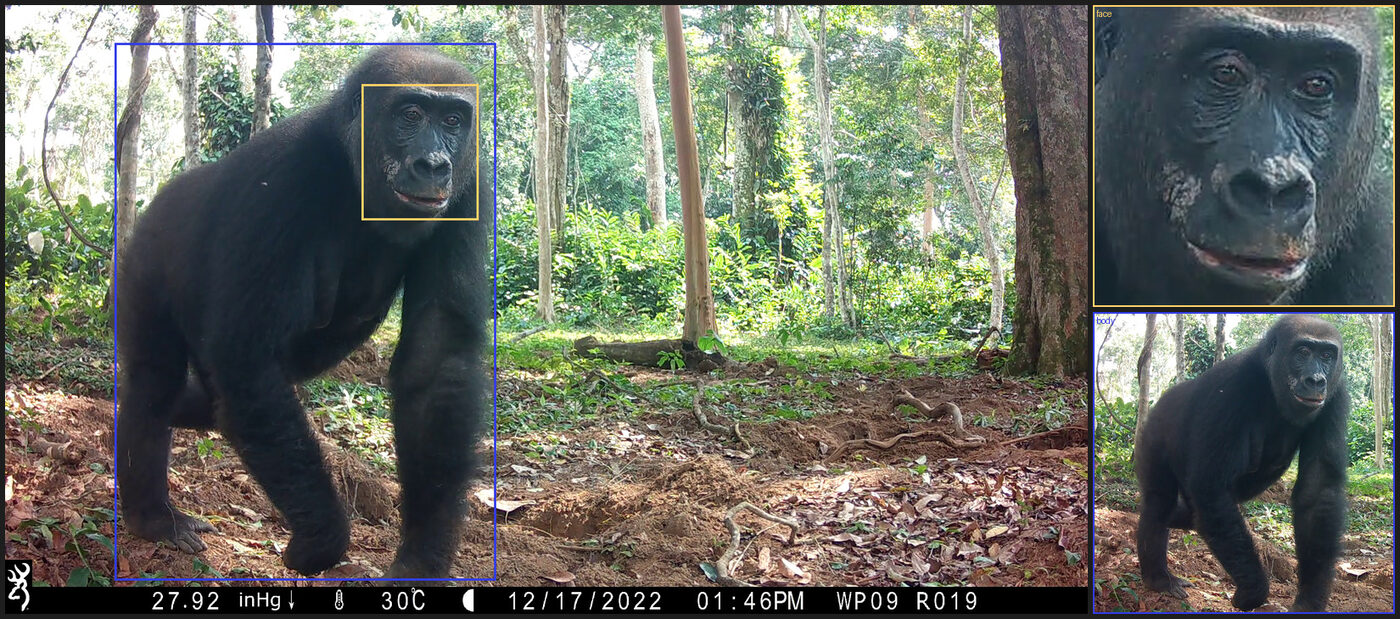
One sample across the dataset configurations: the full camera trap frame with the detected face (orange) and body (blue) boxes, and the squared crops that are fed to the re-ID models.
Show 5 more examples Hide examples
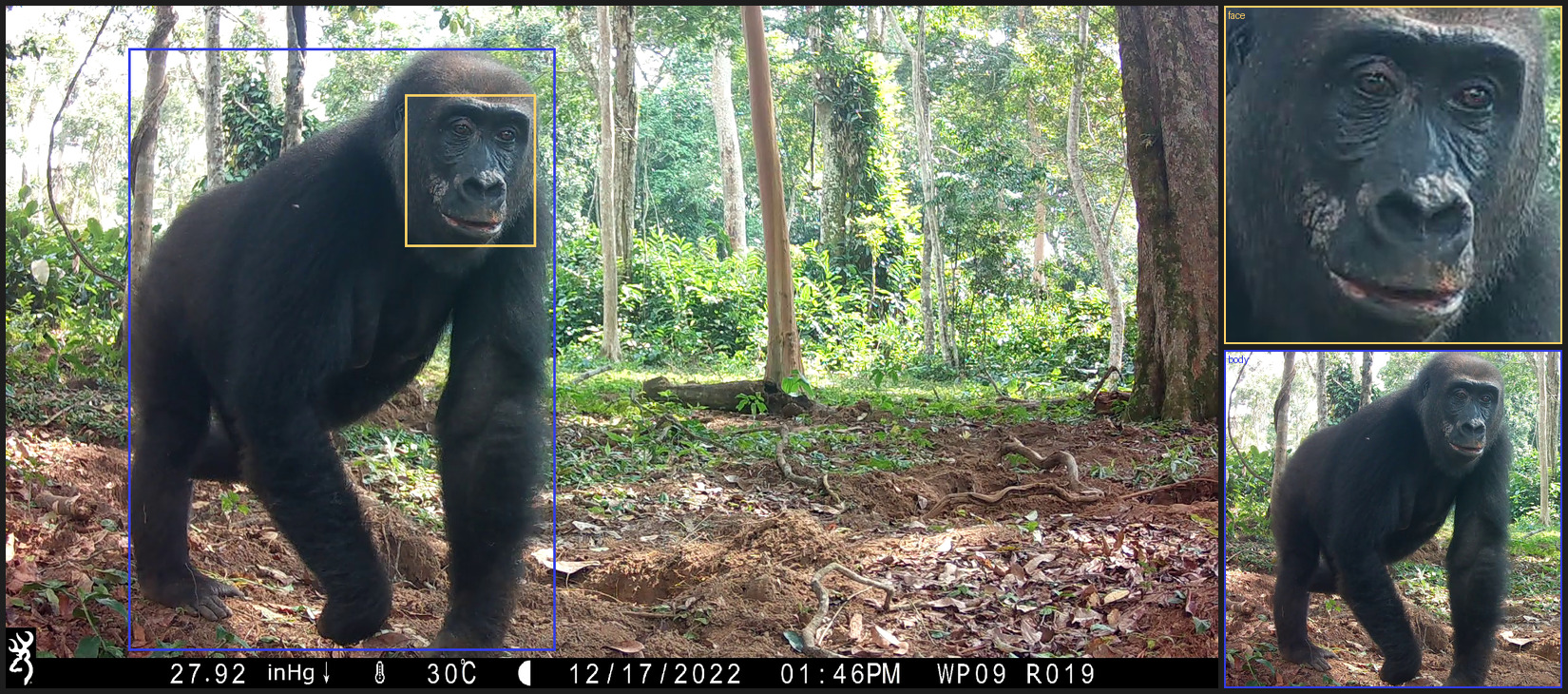
NN02 · the example shown above
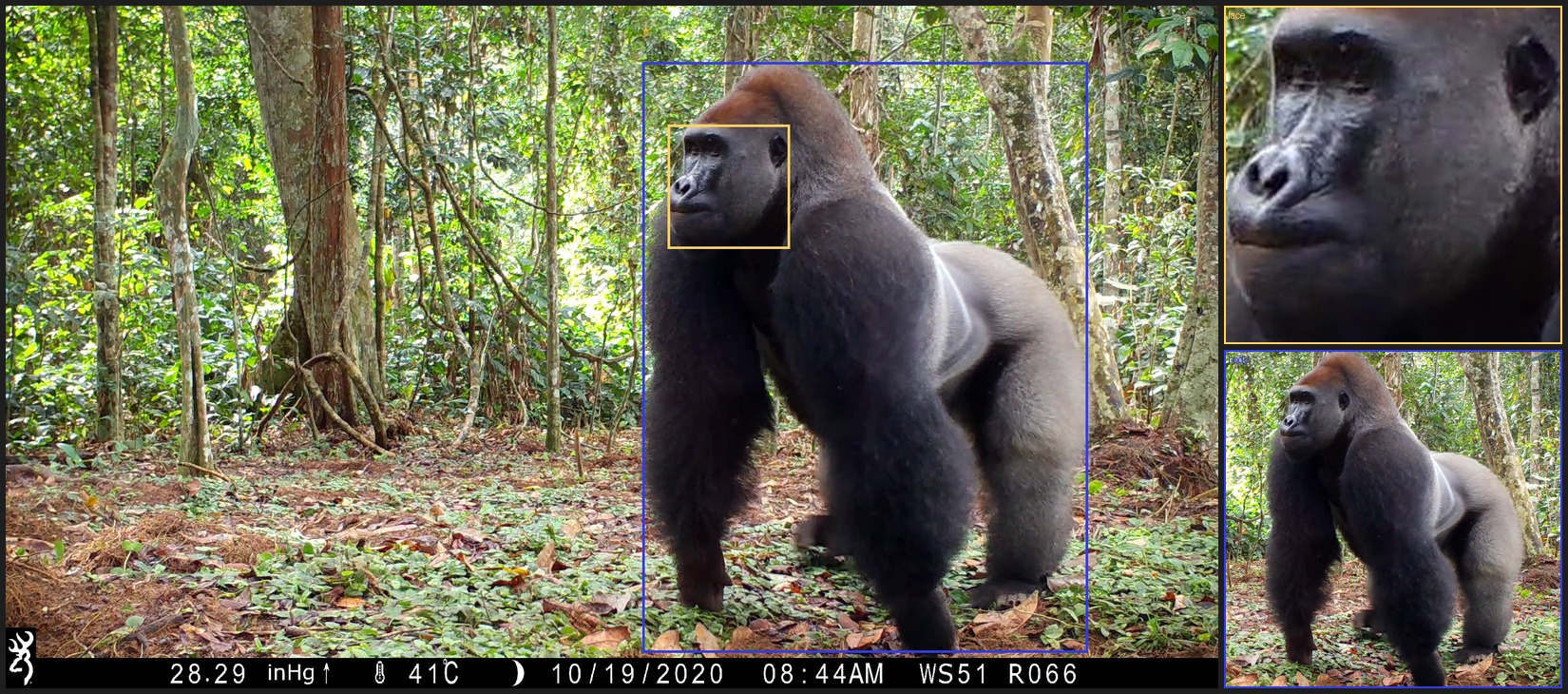
ES00 · silverback at close range
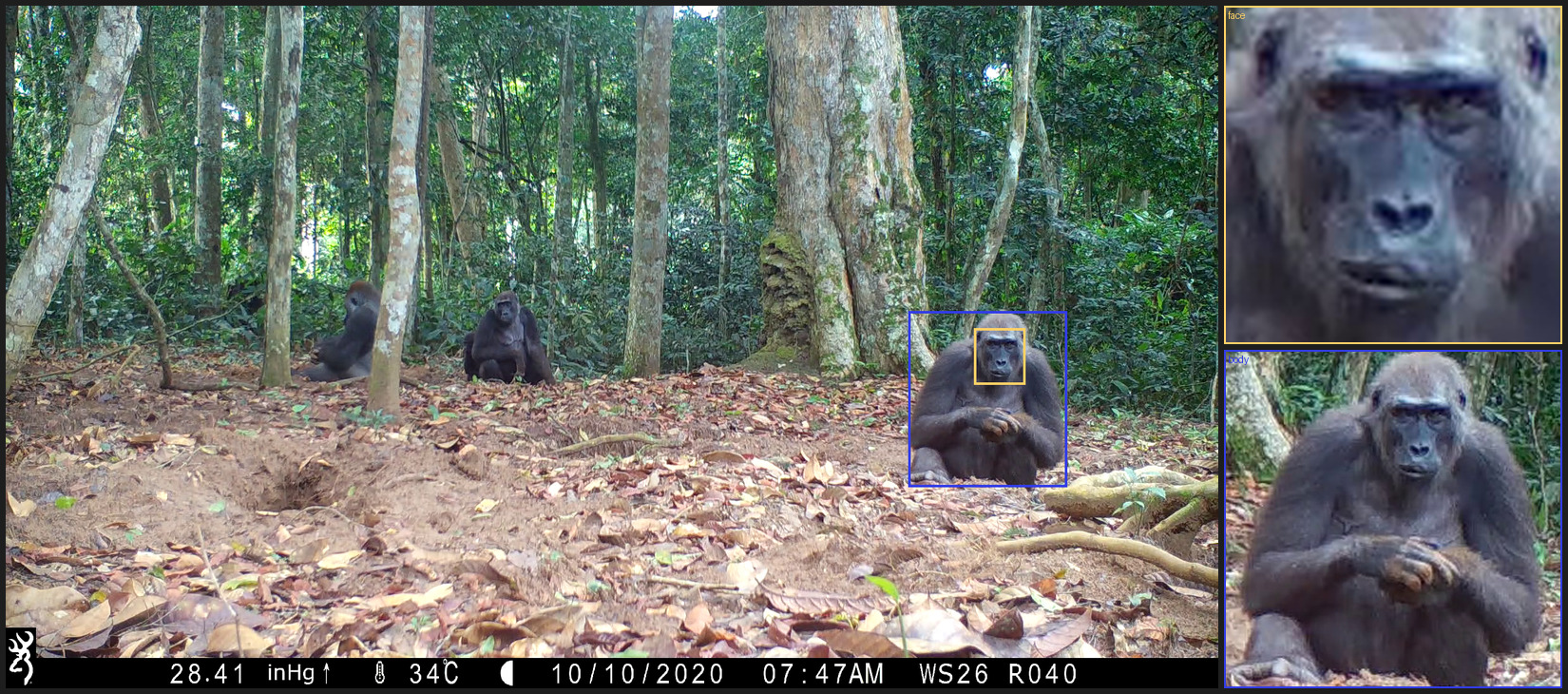
AY04 · several gorillas in one frame
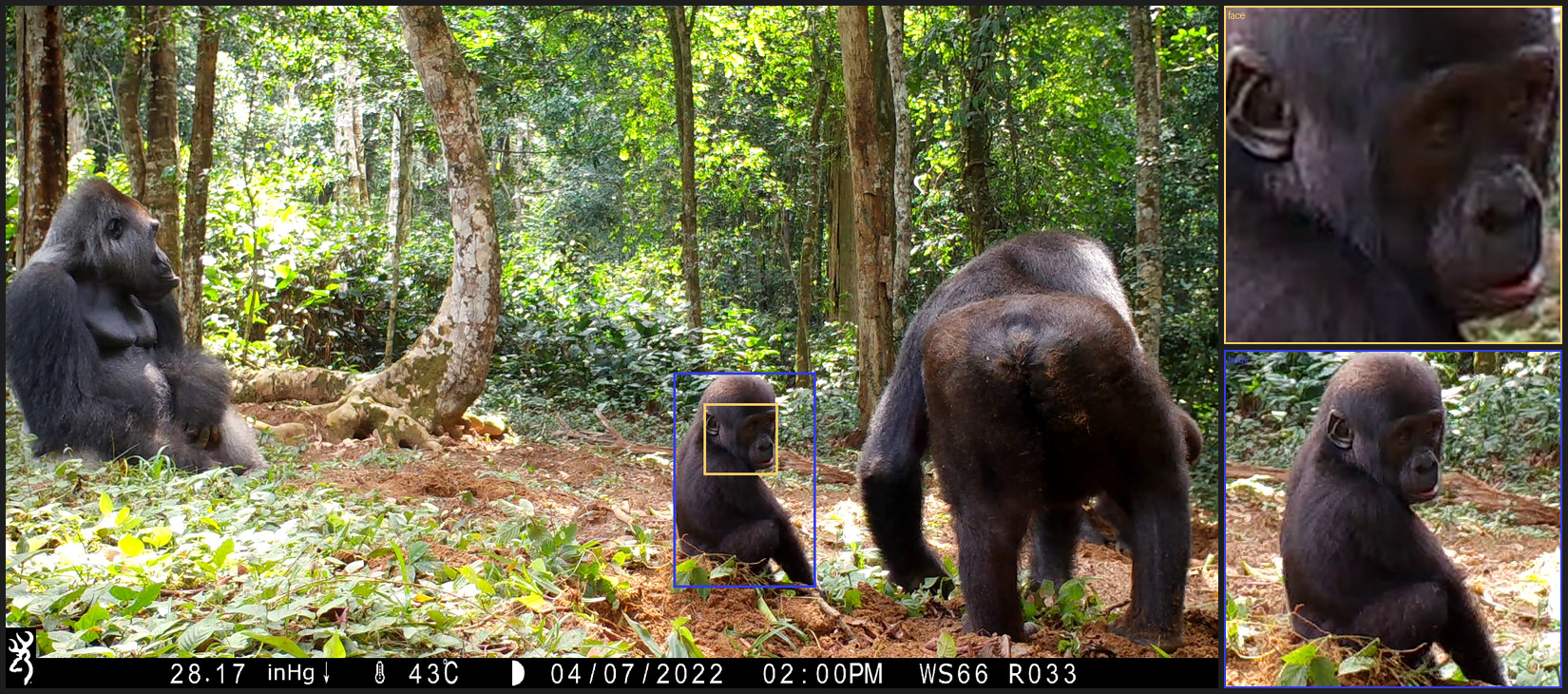
JP60 · baby gorilla
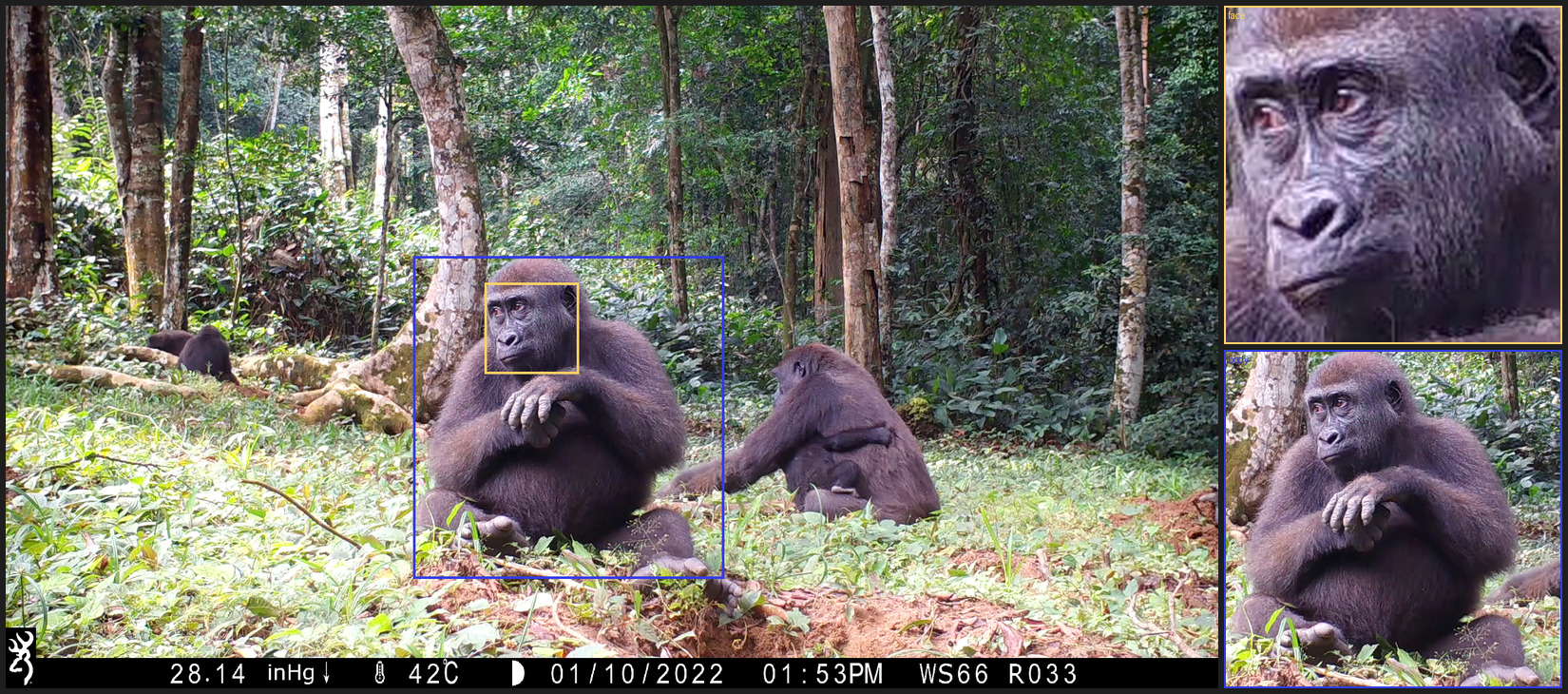
US42 · juvenile gorilla
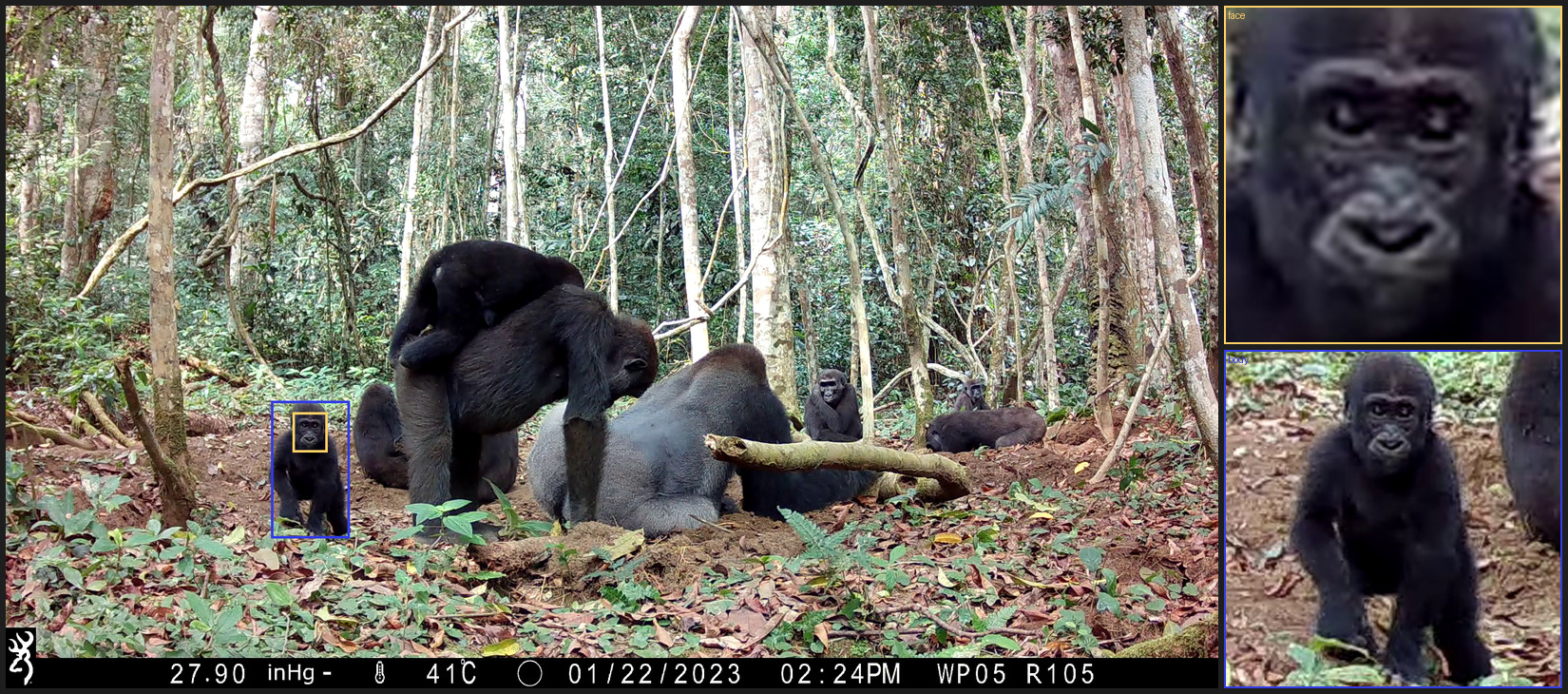
RC61 · baby gorilla
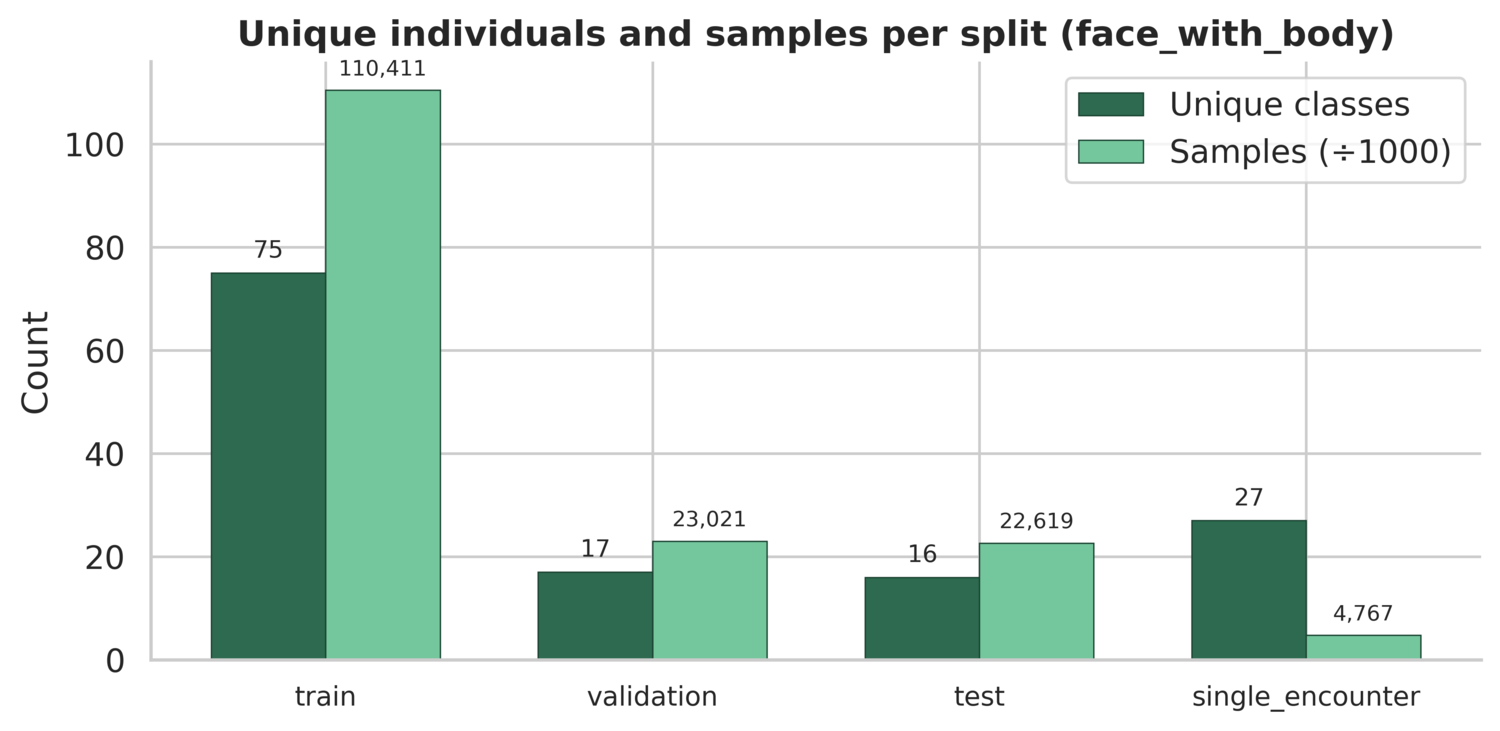
Class-disjoint splits, plus a single_encounter set holding the 27 individuals that were seen only once and therefore cannot be used for cross-encounter evaluation.
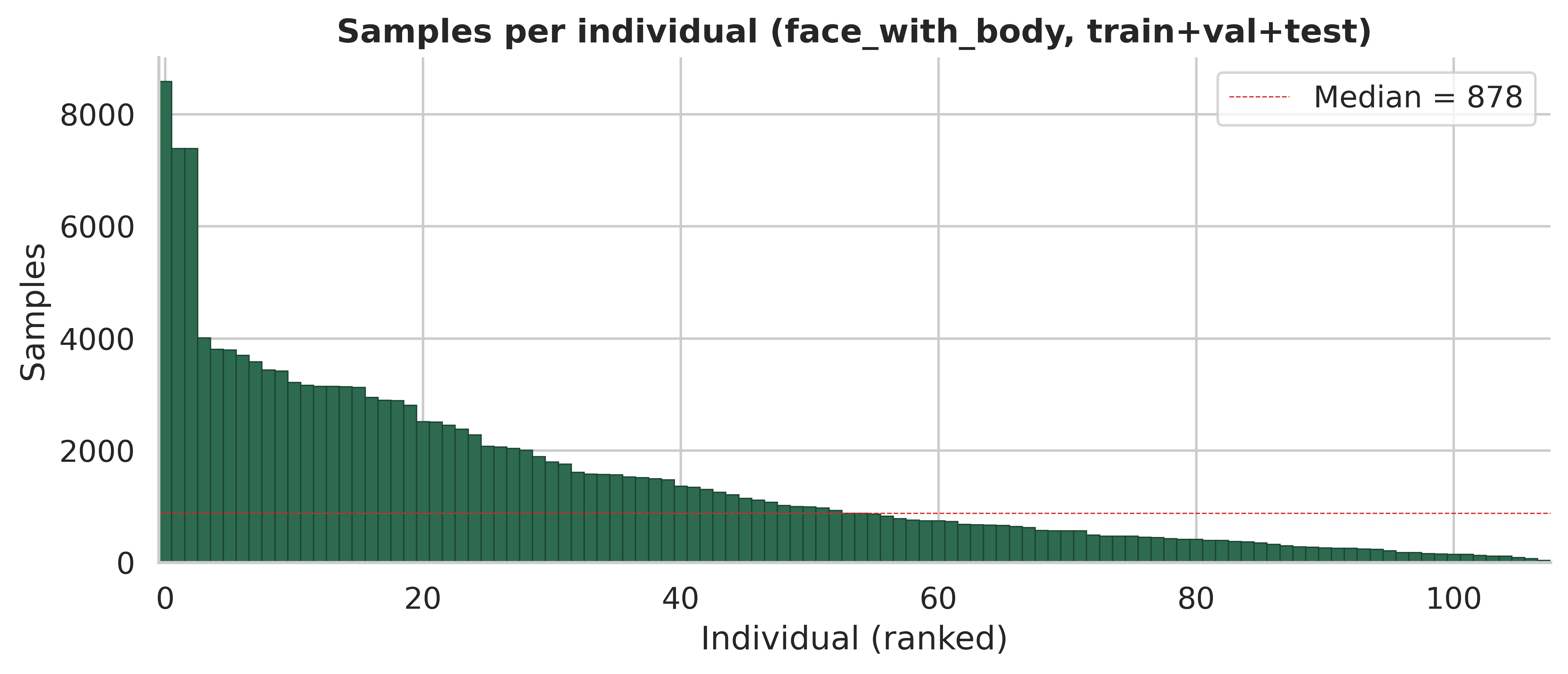
Class distribution in the face_with_body configuration (excluding the single encounter split). We notice a heavy imbalance in the sample counts across the different classes.
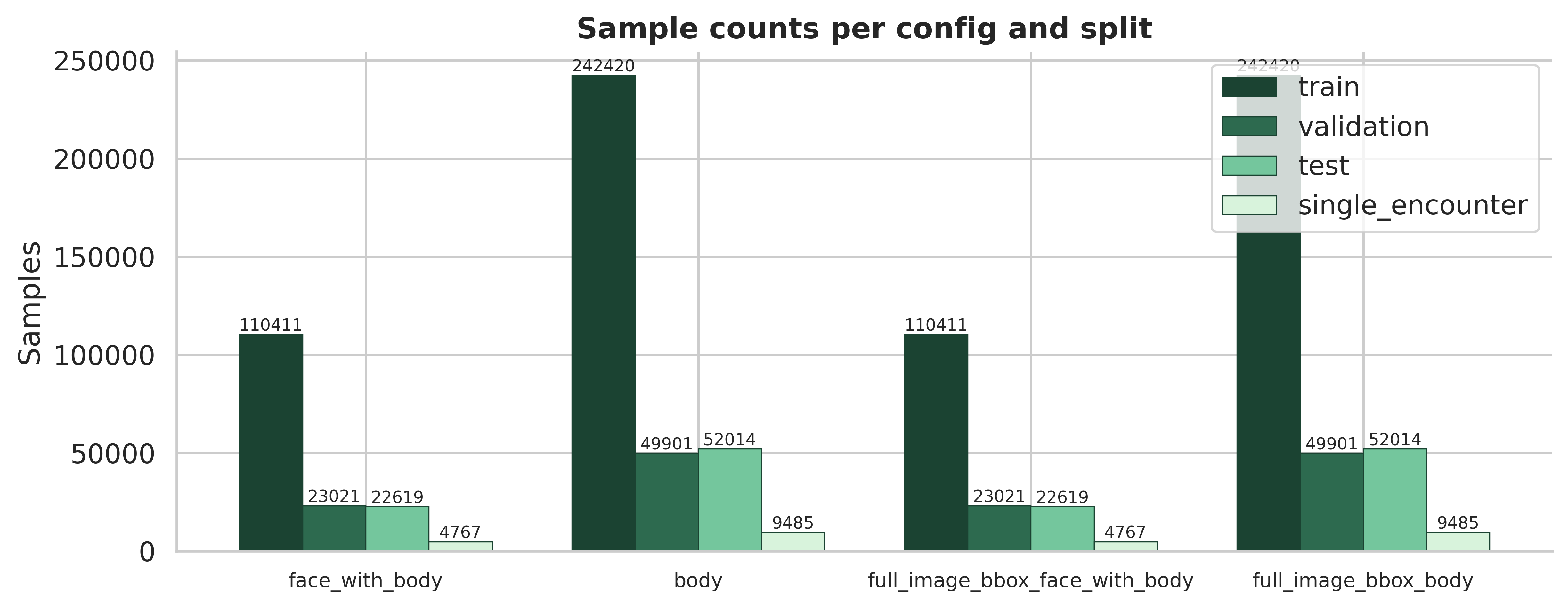
Sample counts in the four dataset configurations.
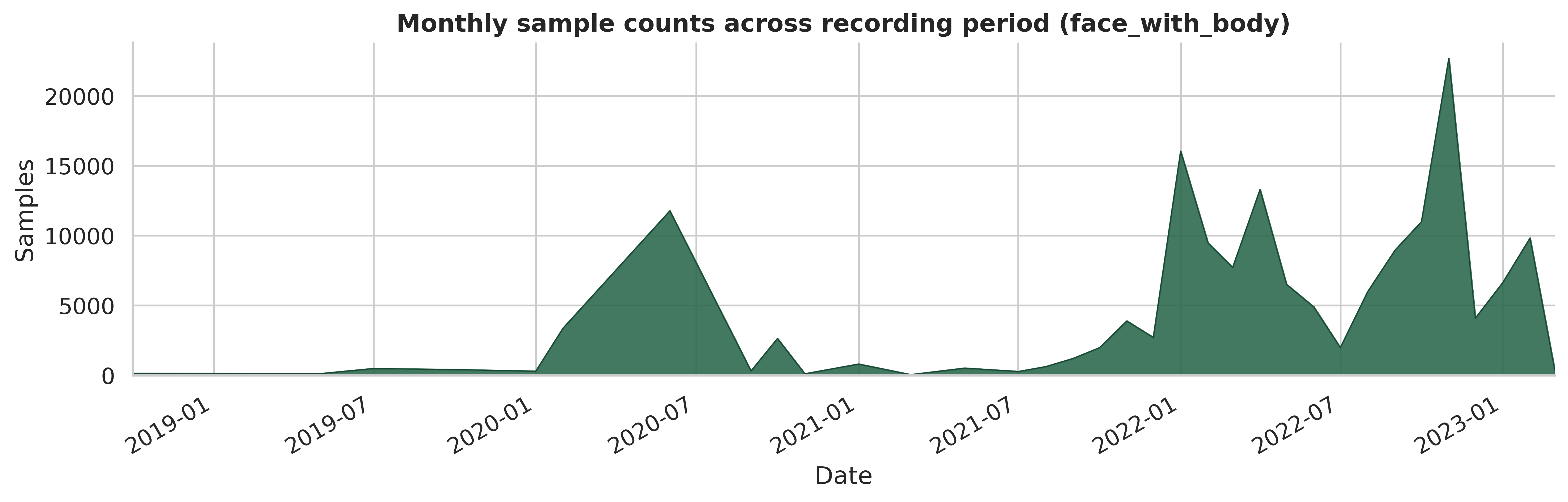
Temporal coverage of the face_with_body configuration.
Gorilla-Zoo-Berlin
Cross-domain evaluation benchmark · Zoo Berlin, Germany
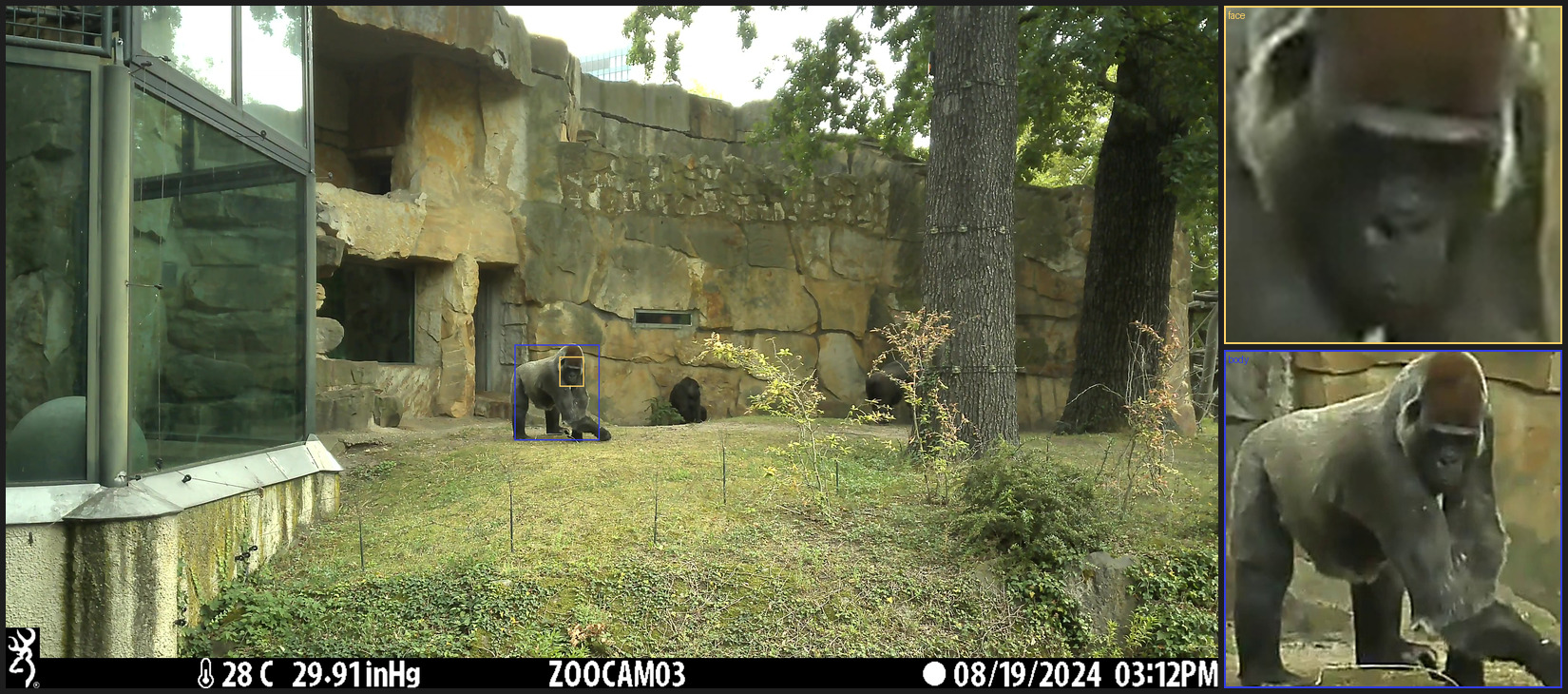
The same camera trap setup, moved to a controlled environment: one social group of five gorillas, filmed from four fixed viewpoints over three months, labelled by their caretakers. Artificial structures, glass and unfamiliar camera angles make it a genuine domain shift, which is why the dataset ships as a single test split. It measures how well models trained on rainforest footage generalize.
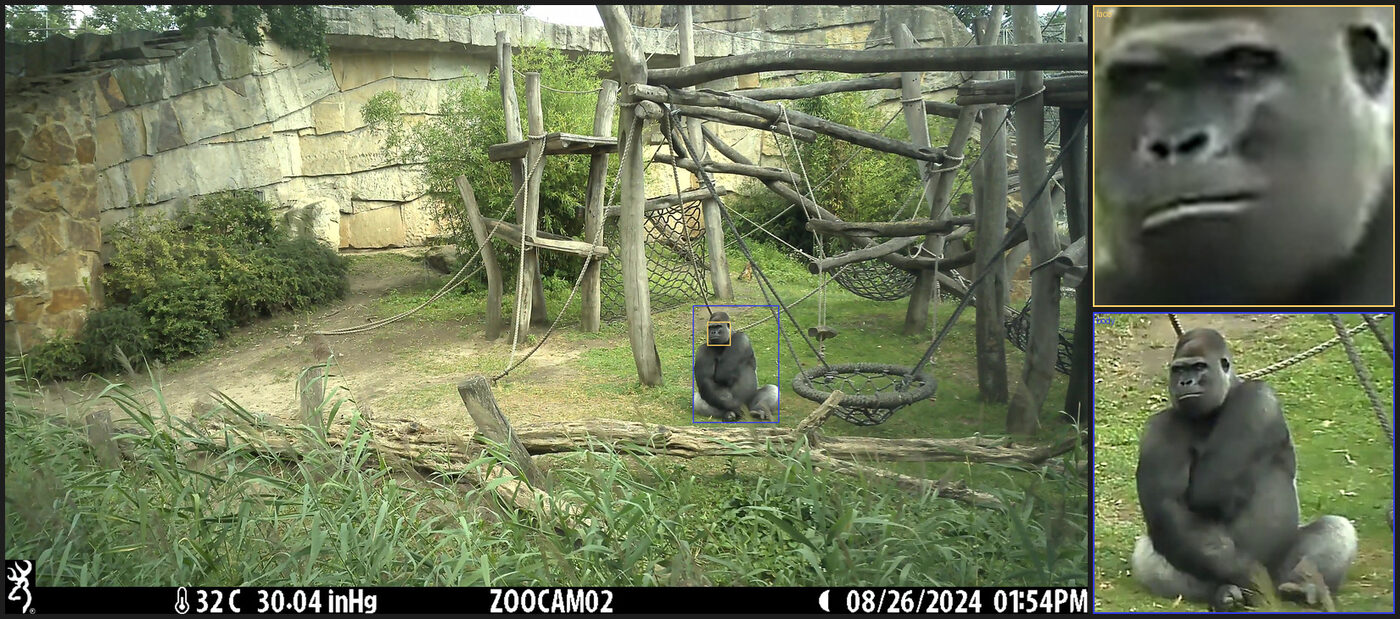
A zoo sample in the same format. Subjects are frequently small in frame, so face crops are considerably lower in resolution than in close-range wild encounters.
Show 5 more examples Hide examples
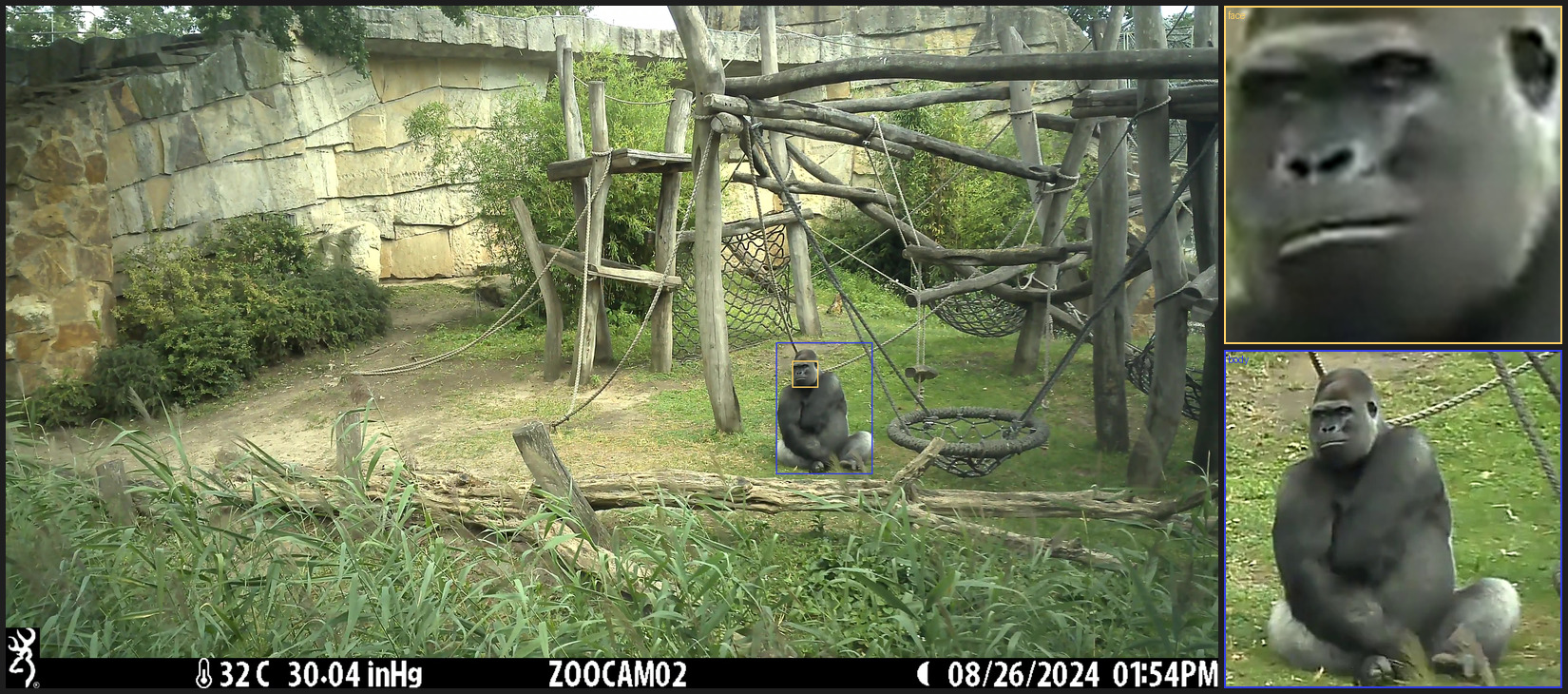
Sango · the example shown above
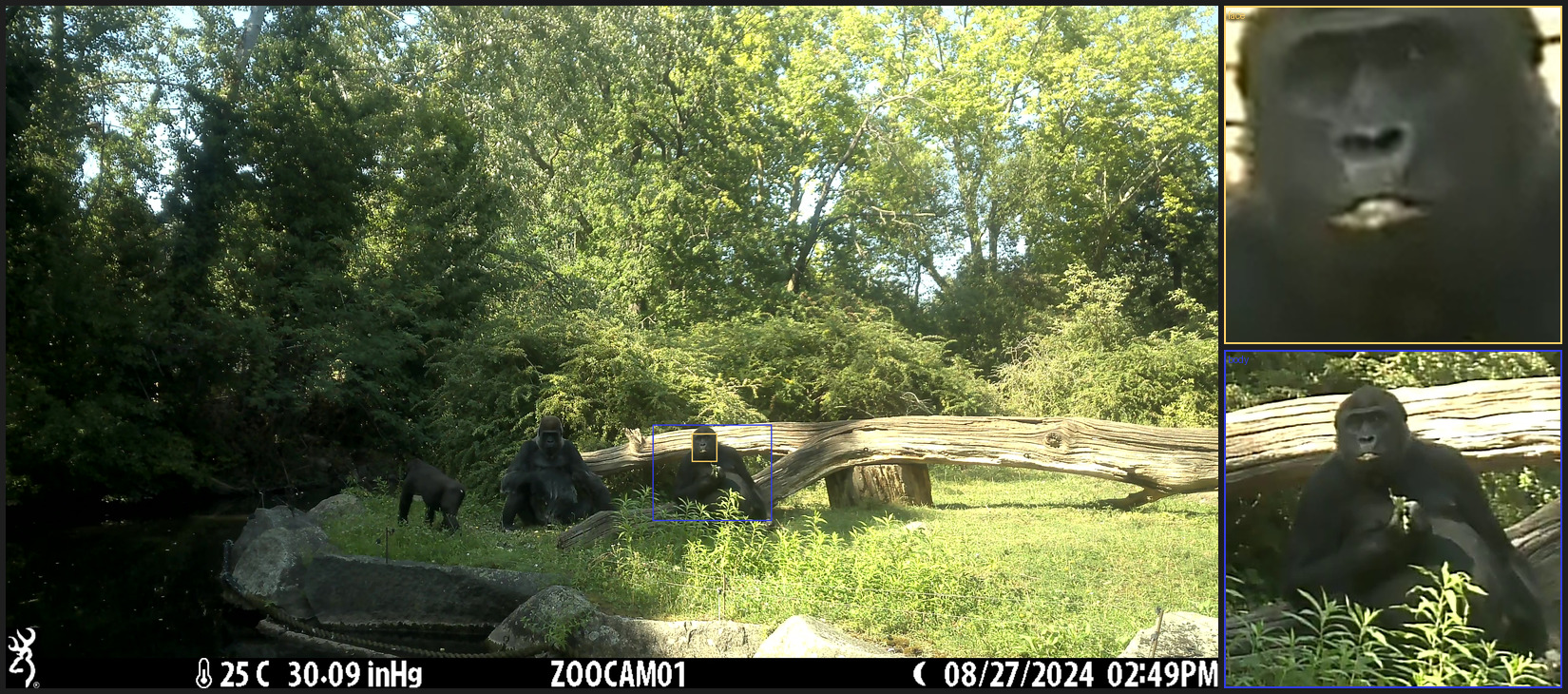
Djambala
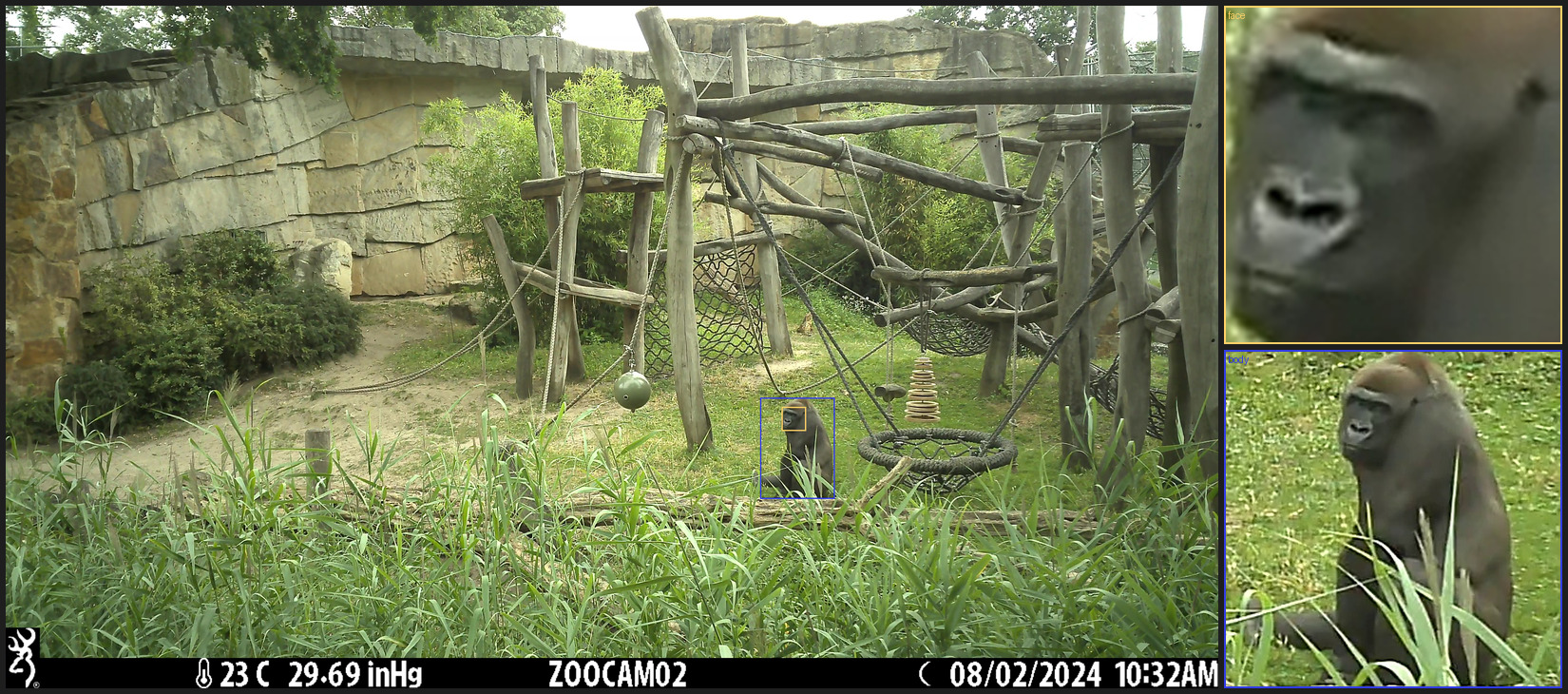
Bibi
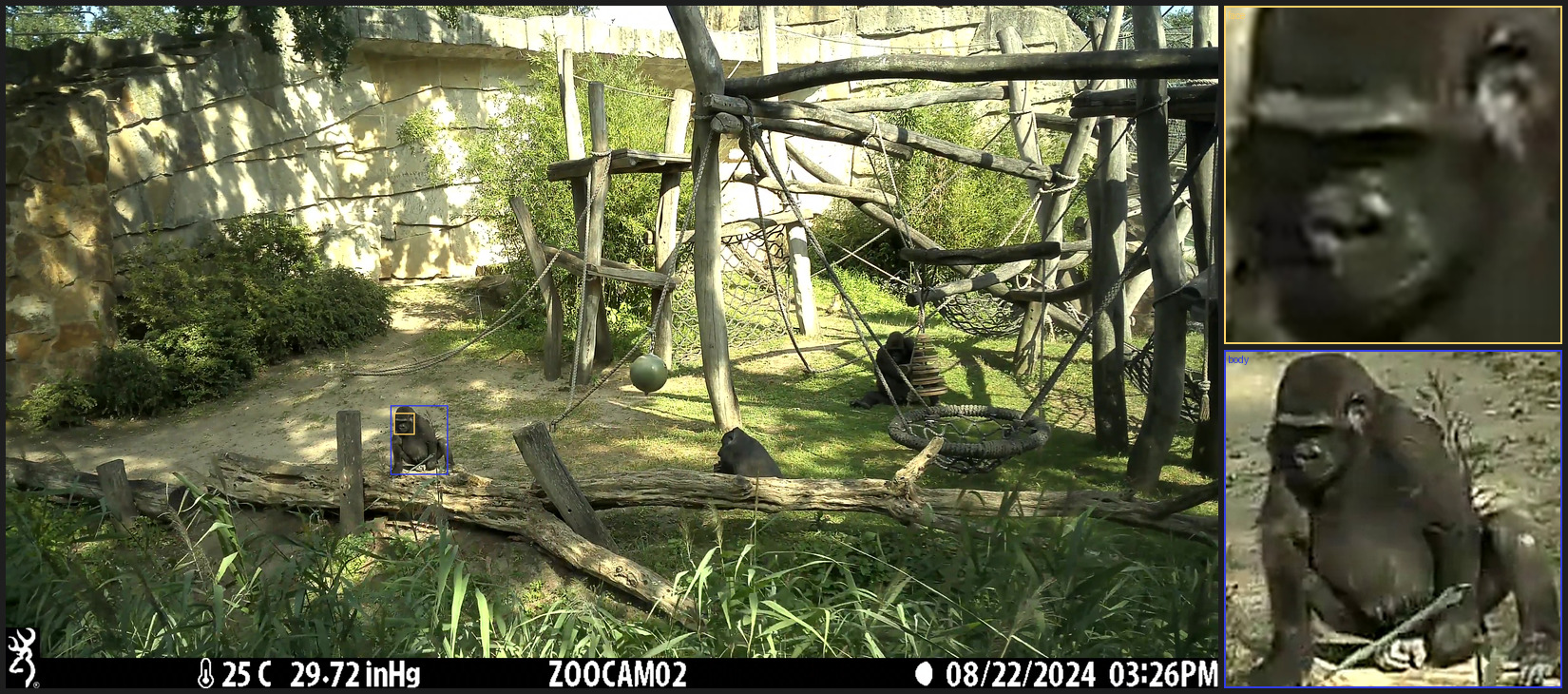
Tilla
M'Penzi
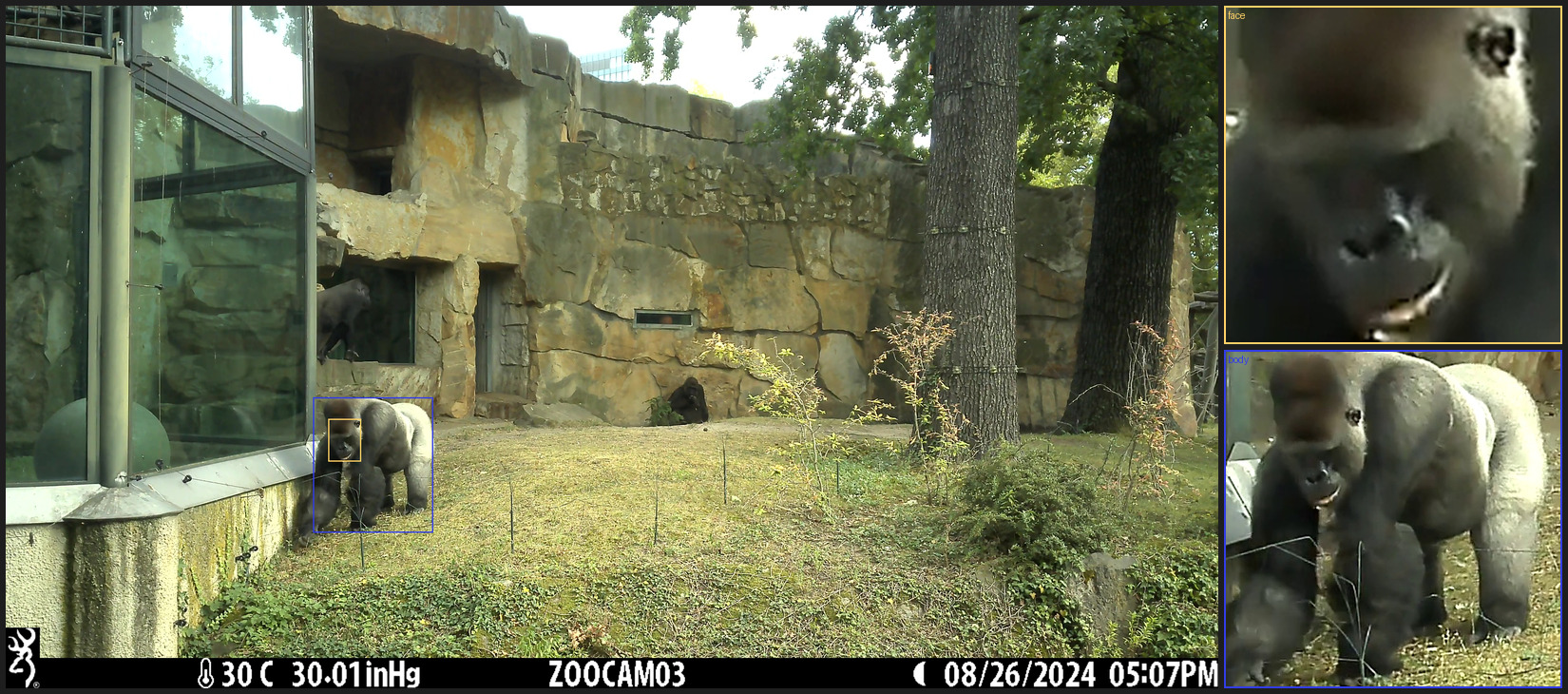
Sango
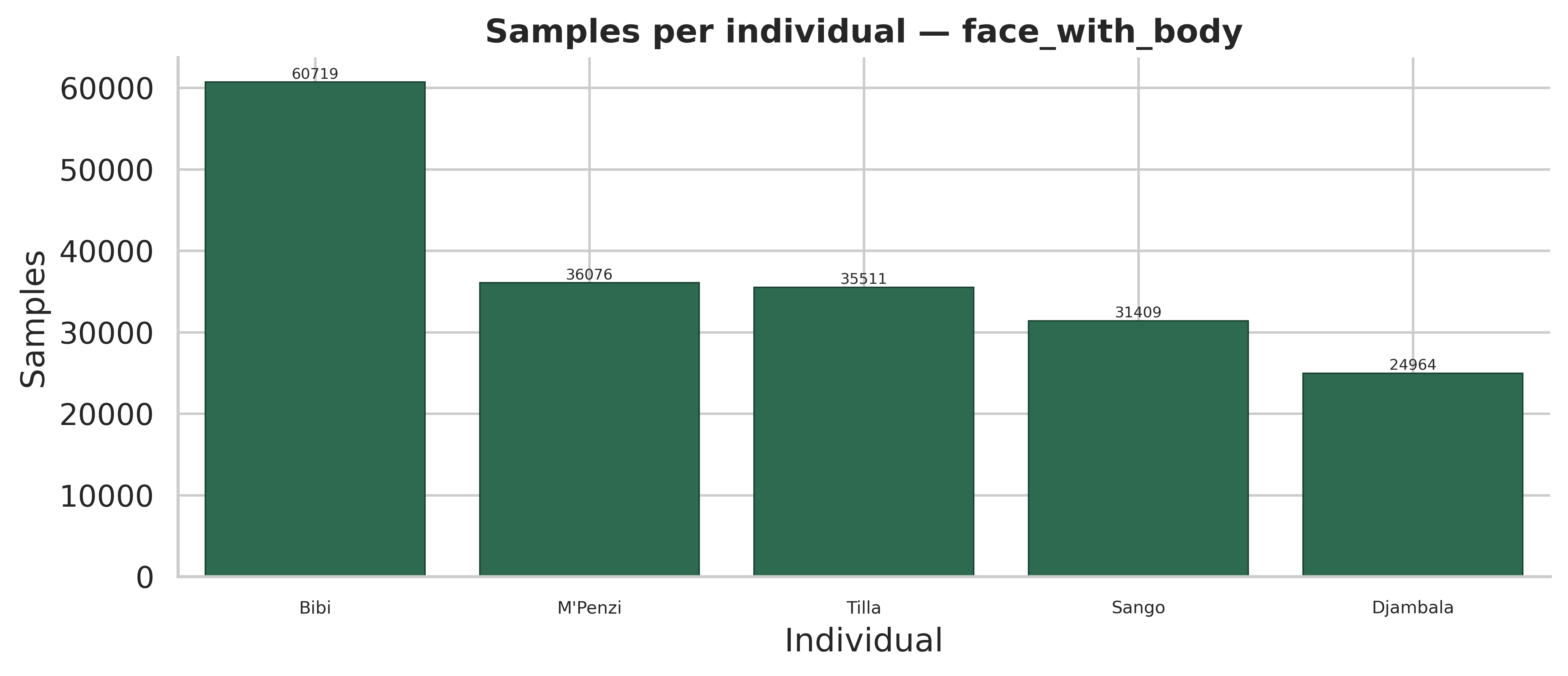
Class distribution in the face_with_body configuration. The five individuals here are much more balanced.
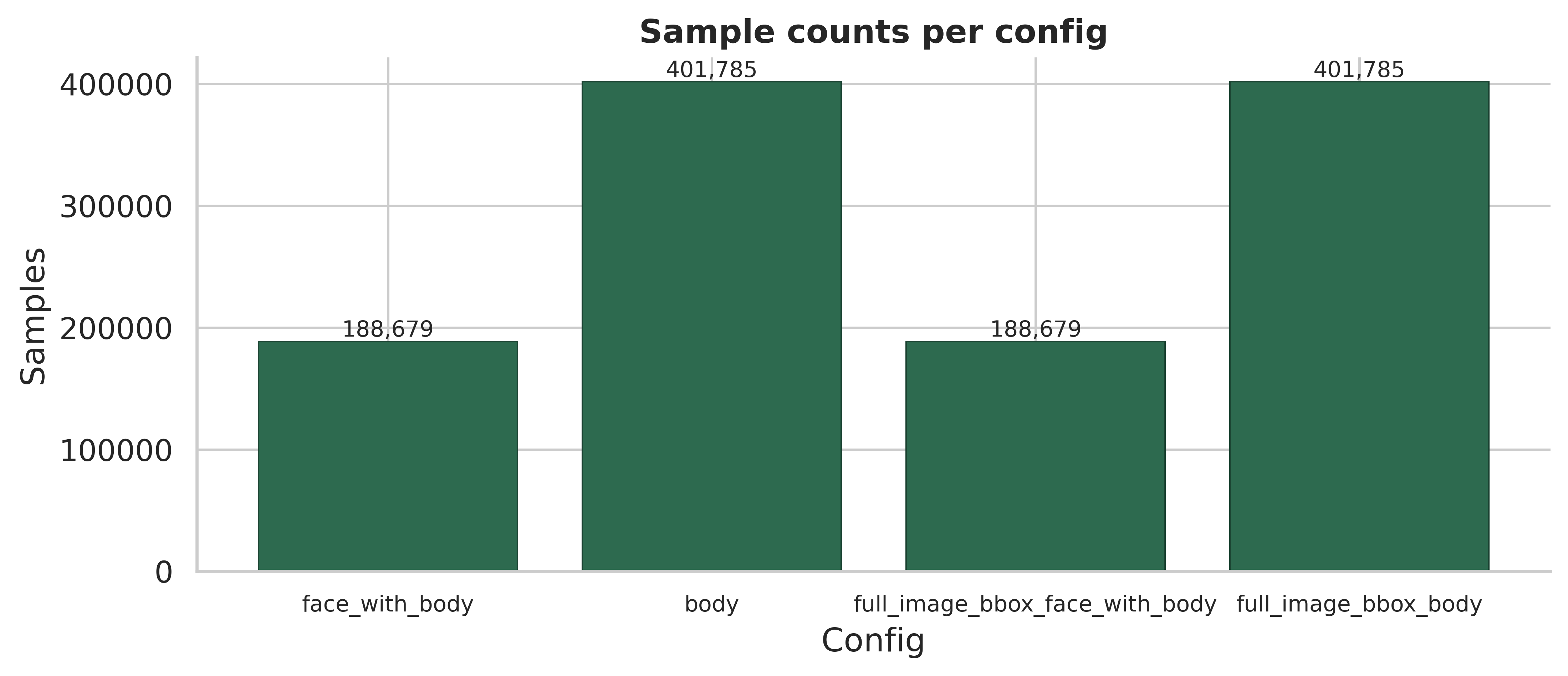
Sample counts in the four dataset configurations.
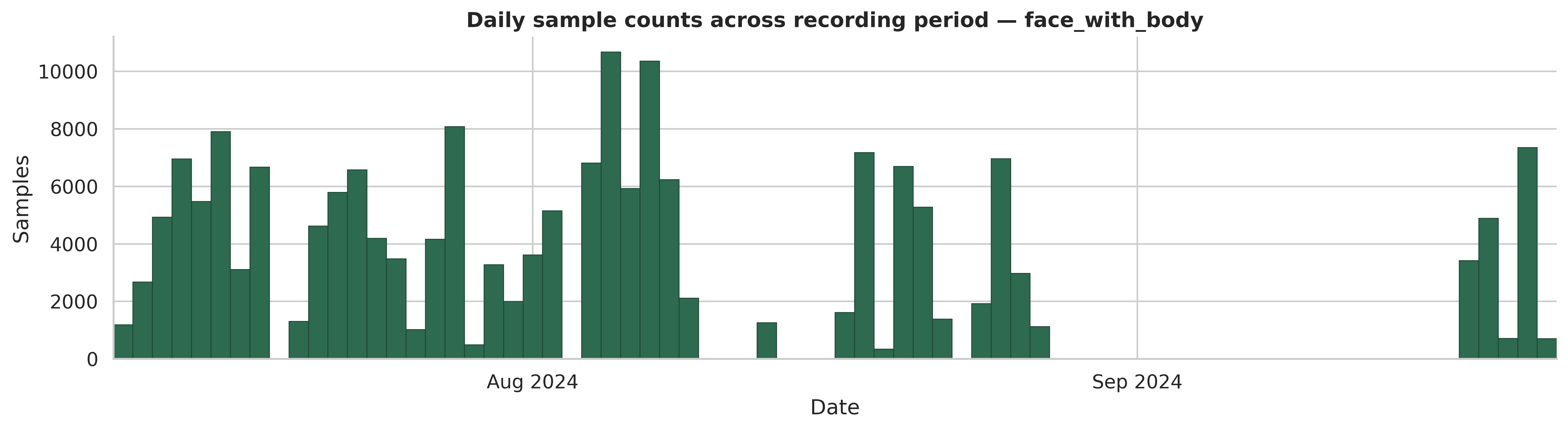
Temporal coverage of the face_with_body configuration.

The four fixed viewpoints covering the enclosure.
Gorilla-SPAC-MoT
Multi-object tracking benchmark · Odzala-Kokoua National Park, Republic of Congo
Densely annotated camera trap videos for the tracking stage of the pipeline, labelled manually frame by frame.
Sequences are graded by difficulty: 16 hard videos with frequent multi-individual interaction and heavy
occlusion (about four individuals on average) and 9 easy videos with little interaction, split into 13
validation and 12 test sequences. Everything follows the standard MOT Challenge layout
(seqinfo.ini, gt/gt.txt, img1/), so existing trackers run on it without
conversion — this is the benchmark behind our tracker comparison.
Shared format. The two re-identification datasets come in four configurations:
face_with_body (paired face and body crops), body (body crops only), and two
full_image_bbox_* variants that keep the original video frame together with the detection boxes.
Every sample carries its individual ID, source video, frame number, camera and date. The source videos are
released alongside the images, and all three datasets are licensed under CC-BY-4.0.
Pipeline Overview
Our end-to-end GorillaWatch pipeline consists of four main stages:
- Detection: Automated gorilla detection in camera trap footage
- Tracking: Multi-object tracking to maintain individual identities across frames
- re-ID Model: Deep learning-based feature extraction for individual recognition
- Constrained Clustering: Spatiotemporal clustering for population counting and identity prediction
Key Results
Spatiotemporal Constrained vs. Unconstrained Clustering
| Method | ARI ↑ | AMI ↑ | # Clusters |
|---|---|---|---|
| Unconstrained | |||
| HAC | 0.606 | 0.728 | 465 |
| DBSCAN | 0.379 | 0.625 | 341 |
| HDBSCAN | 0.114 | 0.510 | 113 |
| Constrained (Spatiotemporal) | |||
| HAC | 0.837 | 0.891 | 17 ✓ |
| DBSCAN | 0.586 | 0.873 | 13 |
| HDBSCAN | 0.184 | 0.677 | 204 |
Spatiotemporal constrained clustering significantly improves accuracy and reduces over-segmentation, with HAC achieving the best performance.
Comprehensive Analyses
🔍 Tracker Comparison
Detailed comparison of state-of-the-art multi-object tracking methods evaluated on our Gorilla-SPAC-Multi-Object-Tracking dataset.
🧠 Backbone Zero-Shot Benchmark
Systematic comparison of pre-trained embedding models, demonstrating that ensemble methods outperform specialized video models for gorilla re-identification.
📊 DINOv2 Scaling Analysis
Accuracy vs. model size analysis (Small → Giant) after fine-tuning, showing performance improvements across model scales.
🎬 Video Architecture Deep-Dive
Full results including the effect of replacing standard Vision Transformers with DINOv2 backbones in video architectures.
Visual Overview

Pipeline Architecture: End-to-end workflow from Detection → Tracking → re-ID Model → Clustering for ID Prediction.
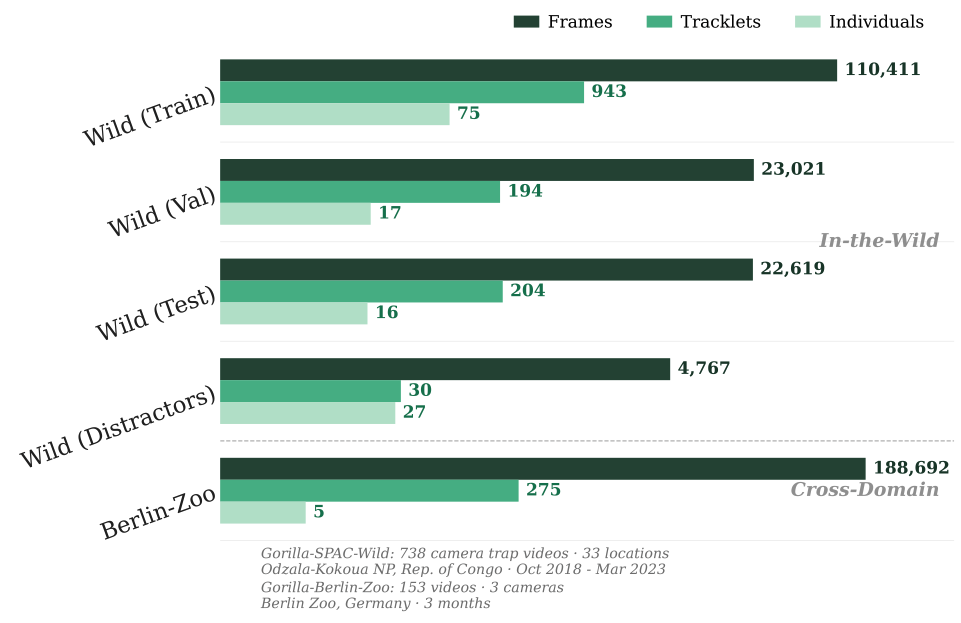
Dataset Scale: 110K+ frames from wild camera traps and zoo videos across multiple locations.
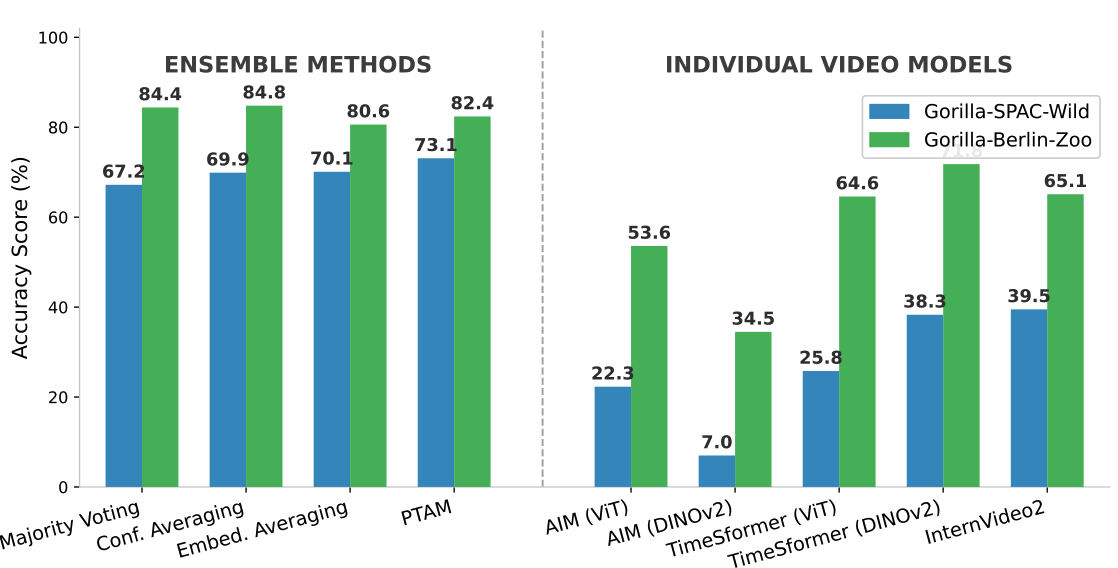
Key Finding: Ensemble methods (84.8% accuracy) significantly outperform individual video models.
BibTeX
@inproceedings{schall2026gorillawatch,
  title={GorillaWatch: An Automated System for In-the-Wild Gorilla Re-Identification and Population Monitoring},
  author={Schall, Maximilian and Kn{\"o}fel, Felix Leonard and K{\"o}nig, Noah Elias and Kubeler, Jan Jonas and von Klinski, Maximilian and Linnemann, Joan Wilhelm and Liu, Xiaoshi and Schlegelmilch, Iven Jelle and Woyciniuk, Ole and Kudaeva, Alexandra and Wasmuht, Dante and Bermejo Espinet, Magdalena and Illera Basas, German and de Melo, Gerard},
  booktitle={Proceedings of the IEEE/CVF Winter Conference on Applications of Computer Vision (WACV)},
  year={2026},
  url={https://gorilla-watch.github.io}
}
Acknowledgments
The project on which this report is based was funded by the Federal Ministry of Research, Technology and Space under the funding code "KI-Servicezentrum Berlin-Brandenburg" 16IS22092. We acknowledge the support of Sabine Plattner African Charities (SPAC) for their funding to this research. We are grateful to Zoo Berlin for their expert assistance and facility access. This collaboration enabled the development of AI tools capable of being deployed in the wild to directly support gorilla conservation. The responsibility for the content of this publication remains with the authors.